
Paris Hidden Gems: Secret Spots & Local Tips Only Guides Know (2026)
Everyone sees the same Paris. The Eiffel Tower at dusk. The Louvre queue at 9am. The crêpe stand on the corner of every tourist street. And none of it is wrong — those things are iconic for a reason, and they deserve their reputation.
But here's what most first-time visitors don't realise until they come back for a second or third trip: the Paris that stays with you is rarely the Paris in the guidebooks. It's the courtyard you stumbled into by accident, the viewpoint that wasn't on any map, the neighbourhood bar where the locals looked up when you walked in — not because you were unwelcome, but because they were surprised anyone had found the place.
Paris has more layers than almost any city on earth. Twenty arrondissements, 2,000 years of continuous history, and a culture that genuinely prizes the hidden, the discreet, and the unexplained. This guide peels back those layers. It's written by people who walk Paris every single day — our guides at StellarTours — and it covers the secret spots, overlooked neighbourhoods, and local insider tips that transform a good trip into an unforgettable one.
Why the Best Paris Experiences Are Never the Obvious Ones
There's a reason experienced travellers come back to Paris again and again: the city rewards attention. Every neighbourhood has a different personality. Every street has a story. And the more you slow down and look — really look — the more Paris gives back.
The shift in how people want to travel is visible in the data. Searches for "Paris hidden gems", "secret spots Paris", and "non-touristy things to do in Paris" have grown consistently year on year. Travellers are tired of shuffle-through tourism. They want to feel something. They want to understand a place, not just photograph it.
The good news: Paris is exceptionally well-suited to this kind of travel. And a free walking tour — the kind where a passionate local guide actually walks you through the stories, the secrets, and the overlooked corners — is the single most efficient way to find it.
Hidden Gems in the Historic Heart of Paris
The Crypte Archéologique: Paris Beneath Paris
Directly in front of Notre-Dame Cathedral, underneath the Parvis Notre-Dame, lies one of the most extraordinary and least-visited sites in the city: the Crypte Archéologique. Descend underground and you're standing in the ruins of Roman Paris — the city that existed here 2,000 years before the cathedral above you was built. Medieval walls, heating systems, ancient roads. Entry is inexpensive and the space is almost always quiet, even in peak season.
Most visitors walk straight over it. Our guides on the Paris City Centre free walking tour stop above it, tell you what's underneath, and give you the context to make it meaningful when you go down.
Sainte-Chapelle: The Gothic Masterpiece Nobody Queues For
Two minutes from Notre-Dame, hidden inside the gates of the Palais de Justice on the Île de la Cité, is Sainte-Chapelle — arguably the most beautiful interior space in Paris, and one that a significant portion of tourists simply never visit because they don't know it's there.
Built in 1248 to house what was believed to be the Crown of Thorns, the upper chapel is a wall-to-wall explosion of 15 stained-glass windows rising 15 metres high. On a sunny day, the light transforms the entire room into something that doesn't feel architectural at all. It feels like standing inside a jewel. The queue is a fraction of Notre-Dame's. The experience is, many people feel, superior.
Square du Vert-Galant: The Prow of the Île de la Cité
Walk to the very western tip of the Île de la Cité — past the Pont Neuf, down the stone steps — and you find the Square du Vert-Galant. It's a small garden at river level, tucked beneath the bridge, surrounded on three sides by the Seine. Parisians come here on warm evenings to sit, read, and watch the river go by. Tourists almost never make it down the steps.
The Pont Neuf above it is Paris's oldest bridge — and our guides will tell you it has something else: if you look closely at the stone keystones along the bridge's arches, each one is carved with a different face. No two are alike. Nobody knows for certain what they represent. That's Paris in miniature — beautiful, ancient, and still slightly mysterious after all this time.
Our Paris City Centre tour passes directly through all of this.
Hidden Gems in Montmartre
The Vineyard of Montmartre
Most visitors know that Montmartre was an artists' village. Fewer know it was also — and still is — a wine-producing village. Tucked behind the Sacré-Cœur, on the steep slope of the Rue des Saules, is the Clos Montmartre: a genuine, functioning vineyard right in the middle of Paris, covering 1,556 square metres and producing around 1,500 bottles of wine per year. The harvest each October (the Fête des Vendanges) is one of the most joyful local events in Paris.
The vineyard is free to look at year-round. The wine, sold at auction to benefit local social services, is famously undrinkable — but that's not the point. The point is that this village on a hill in the middle of one of the world's most visited cities quietly makes wine, every year, as it has done since the 12th century.
Our Montmartre free walking tour walks you past the vineyard and tells you the full story — including why Montmartre resisted joining the city of Paris for as long as it possibly could.
Le Mur des Je T'aime (The Wall of Love)
In a small garden at the foot of the Butte Montmartre, squeezed between the Abbesses Métro station and the steps that climb toward the Sacré-Cœur, is one of the most touching hidden gems in Paris: Le Mur des Je T'aime — the Wall of Love.
It's a large tile installation covered in 612 fragments of a shattered heart, spelling out "I love you" in 250 different languages. Created in 2000 by artist Frédéric Baron and calligrapher Claire Kito, it was assembled from 300 people's handwritten "I love you" in every language they knew. It's free to visit, it's genuinely moving, and almost no tourists who don't already know about it find it by themselves.
The Hidden Stairways of Montmartre
Montmartre is built on a hill, and its staircases are one of its greatest pleasures — dozens of them, winding between streets, through gardens, past ivy-covered walls and small neighbourhood squares that feel entirely removed from the city below. The Escalier de la Bonne Franquette, the steps along the Rue Chappe, the hidden passage through the Villa Léandre: these are the routes that local residents take every day and that guided walks reveal.
The Montmartre cemetery, hidden below street level in a kind of natural bowl, is another of the neighbourhood's overlooked treasures. The graves of Degas, Berlioz, Truffaut, Dalida, and dozens of other French cultural luminaries lie here in a space that feels intimate and unhurried in a way that Père-Lachaise — more famous, more visited — never quite does.
Hidden Gems in the Latin Quarter
The Arènes de Lutèce: A Roman Amphitheatre in Central Paris
Hidden behind an unremarkable gate on the Rue Monge, a short walk from the Seine, is one of the most extraordinary archaeological sites in Paris: the Arènes de Lutèce, a Roman amphitheatre built in the 1st century AD that once held 17,000 spectators.
Today, it's a public park. Parisians play pétanque in the arena floor where gladiators once fought. Children kick footballs against ancient stone walls. The entrance is free, it's open every day, and most visitors to the Latin Quarter walk right past the gate without knowing it exists.
Our Latin Quarter free walking tour takes you to the entrance and tells you the full story of Lutetia — the Roman city that became Paris — including why most of its ruins are underground rather than standing, and what happened when the city finally tore itself free from the Roman Empire.
Shakespeare and Company: The Bookshop That Sheltered Hemingway
On the left bank of the Seine, directly facing Notre-Dame, is Shakespeare and Company — one of the most famous independent bookshops in the world and one of the most genuinely atmospheric spaces in Paris. The original shop, founded in 1919, published the first edition of James Joyce's Ulysses. The current incarnation, opened in 1951, gave free shelter and beds to hundreds of young writers over the decades, who slept among the shelves in exchange for working a few hours in the shop.
Hemingway, Fitzgerald, Anaïs Nin, Allen Ginsberg — the walls of this place carry a weight of literary history that is extraordinary for a room this size. Go in, browse, and look up: the mezzanine level has notes written by writers who slept there over the decades. Entry is free. It's the kind of place you stay for two hours when you intended to stay for ten minutes.
The Panthéon's Foucault Pendulum
The Panthéon is visited by many but understood by few. Most people go to see the tombs — Marie Curie, Victor Hugo, Voltaire, Rousseau — which are genuinely extraordinary. But the most remarkable thing in the building hangs from the dome: a Foucault Pendulum, a brass sphere on a 67-metre steel wire, swinging slowly back and forth, its direction gradually rotating throughout the day as the Earth turns beneath it.
Physicist Léon Foucault installed the first version of this experiment here in 1851 — the first public demonstration that the Earth rotates. Watching it is strangely hypnotic. Our guides on the Latin Quarter tour explain the science and the history in a way that makes it genuinely click.
Hidden Gems Beyond the Tourist Trail
The Covered Passages (Les Passages Couverts)
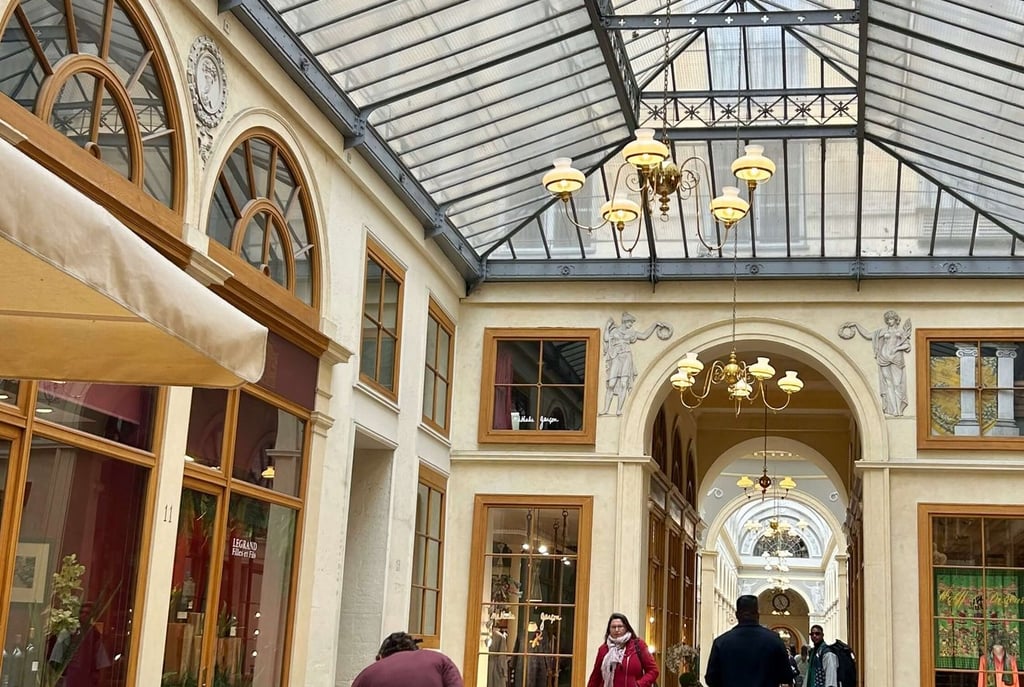
Long before shopping malls existed, Paris invented them. Tucked between the major streets of the 2nd arrondissement are the Passages Couverts — glass-roofed 19th-century shopping arcades, gaslit in their heyday and now home to stamp dealers, antique print shops, specialist booksellers, and quiet cafés that feel completely removed from the city outside.
Galerie Vivienne (Rue Vivienne) is the most beautiful — ornate tilework, classical mosaics, a tea room that dates to 1826. Passage des Panoramas (Boulevard Montmartre) is the oldest still standing, dating to 1799, and has a wonderfully dusty, time-capsule quality. Galerie Véro-Dodat (between Rue Jean-Jacques Rousseau and Rue du Bourg-l'Abbé) is the most theatrical — mahogany columns, painted ceilings, gas-effect lighting, and a silence that feels almost staged.
These passages are completely free to wander and largely empty on weekday mornings. They are among the most transportive spaces in Paris.
The Promenade Plantée: Paris's Original Elevated Park
Before New York built the High Line, Paris built the Promenade Plantée. A former railway viaduct running from the Bastille eastward toward the Bois de Vincennes, it was converted into a 4.5-kilometre elevated garden in 1993. You walk above the rooftops of the 12th arrondissement, through tunnels, past gardens, above streets. It's free, almost always quiet, and one of the best long walks in the city.
Beneath the viaduct, the arches have been converted into the Viaduc des Arts — a row of artisan workshops: violin-makers, furniture restorers, contemporary jewellers, ceramicists, textile designers. A different Paris entirely.
Canal Saint-Martin: Where Parisians Actually Go
While tourists pack the banks of the Seine, the locals who want a warm evening picnic go to the Canal Saint-Martin — a 4.5-kilometre waterway in the 10th arrondissement, lined with iron footbridges, lock gates, and plane trees. On warm evenings the banks fill with Parisians, bottles of wine, and the relaxed noise of a city actually enjoying itself rather than performing enjoyment for cameras.
The neighbourhood surrounding it — indie cinemas, concept wine bars, independent coffee shops, art spaces — is as close to the living, breathing Paris of the moment as you'll find anywhere in the city. It's about 25 minutes on foot from the centre, and completely worth the walk.
How a Walking Tour Unlocks the Hidden Paris
Here's the honest truth about Paris's hidden gems: most of them aren't hidden in the sense of being physically difficult to find. They're hidden in the sense that without context — without the story — they're just another courtyard, another bridge, another building. It's the knowledge that makes them extraordinary.
The Roman amphitheatre is a patch of grass until you understand what it meant for a city to have an arena here 2,000 years ago. The Wall of Love is a tiled surface until you hear the story of how it was made. The Pont Neuf's stone faces are decoration until a guide tells you that nobody knows their purpose and the mystery has been debated for four centuries.
That's what expert local guides do — they don't just show you places, they make those places mean something. And that context, once given, stays with you for the rest of the trip and long after you go home.
At StellarTours, all of our tours are built around exactly this principle. Our City Centre free walking tour covers the historic heart and the secrets of the Île de la Cité. Our Montmartre walking tour takes you into the village behind the postcard. Our Latin Quarter tour excavates the intellectual and ancient history beneath one of Paris's most famous neighbourhoods. And our Musée d'Orsay and Louvre guided tours do the same thing for the museums — replacing overwhelm with understanding.
All tip-based. All led by guides who genuinely love this city. All built to show you a Paris that most visitors never find.
For local dining recommendations to match your hidden-gem exploration, our Paris restaurants and local recommendations guide is put together by our guides — people who eat, drink, and live in these neighbourhoods every day.
Frequently Asked Questions: Paris Hidden Gems
What are the most underrated things to do in Paris?
The Crypte Archéologique beneath Notre-Dame, the Arènes de Lutèce Roman amphitheatre in the Latin Quarter, the Sainte-Chapelle stained-glass chapel on the Île de la Cité, the Passages Couverts in the 2nd arrondissement, and the Promenade Plantée elevated park. All free or very inexpensive, all extraordinary, all consistently overlooked by first-time visitors.
What are the best free hidden gems in Paris?
Many of Paris's best secrets are completely free: the Square du Vert-Galant at the tip of the Île de la Cité, the Arènes de Lutèce, the Wall of Love in Montmartre, the Montmartre vineyard, the Promenade Plantée, and of course all three of StellarTours' tip-based free walking tours — City Centre, Montmartre, and Latin Quarter — which are the most efficient way to discover the stories behind all of them.
How do I find hidden gems in Paris that locals know about?
The most reliable method is a tip-based free walking tour with a local expert guide. A good guide doesn't just take you to places — they give you the knowledge and context to keep finding hidden things throughout your entire trip. After two hours with a StellarTours guide, you'll have a completely different relationship with the city and know exactly where to look.
Are there secret spots near the Eiffel Tower?
Yes. The Champ de Mars itself is obvious, but fewer visitors walk south to the Parc du Champ de Mars for a local picnic experience away from the crowds. The Rue Cler market street nearby is one of the most authentically Parisian food streets in the city — no chains, all local producers. And from Trocadéro, the view of the Eiffel Tower across the Seine is arguably the best in Paris and completely free.
What is the most overlooked museum in Paris?
The Musée Jacquemart-André in the 8th arrondissement — a 19th-century mansion with a world-class collection of Italian Renaissance art in an utterly beautiful building that almost no tourists visit. The Musée Carnavalet (the history of Paris itself, free entry, in a stunning Marais mansion) is another. And the Petit Palais, built for the 1900 World's Fair, with an extraordinary permanent collection and free entry, is perhaps the most consistently underrated major museum in the city.
Is it worth doing a walking tour to find hidden gems in Paris?
Without question. A local guide who walks these streets every day has a depth of knowledge that no guidebook or travel app can replicate — and more importantly, they can adapt to your interests in real time. For hidden gems specifically, a good guide will point out things you'd walk right past: a medieval doorway, a bullet hole from WWII, a view that only opens up from one specific angle. That's what makes StellarTours' free walking tours in Paris one of the most consistently recommended first activities for any visitor to the city.
One Final Thought
The most hidden gem in Paris isn't a place. It's a pace. It's the act of slowing down enough to actually see the city — to take the stairs down to the river, to push open the gate to the courtyard, to ask the guide what that carving on the bridge means.
Paris gives everything to the people who slow down for it. The question is just whether you know where to look.
Find your hidden Paris with StellarTours — book your free walking tour today →
StellarTours is a boutique walking tour company born in Paris. Our expert local guides lead free tip-based and private tours through the city's most iconic and fascinating neighbourhoods — from the historic city centre and Montmartre to the Latin Quarter and beyond. Consistently rated among the best walking tours in Paris on TripAdvisor and Viator.
About StellarTours
Follow us
StellarTours is a boutique company proudly born in Paris.
Our mission is to provide you with a professional, elegant, and always entertaining experience you'll cherish forever.
We hand-pick our guides to ensure that each tour through the heart of Paris is spectacular, so you can travel like a star. Our dedication to exceptional customer service and our knowledgeable guides set us apart as we strive to offer the best guided tours in Paris.
Join us for an unforgettable adventure and see Paris through the eyes of our passionate expert guides. Let StellarTours be your guide in Paris!